
Personalize Content To Connect With Your Audience And Build Loyalty
Each one of us like special treatment, don’t we? Like a message or any content exclusively addressed to you. Isn’t that a kind of awesome feeling? So this is what we refer to as Personalize Content.
Personalization is not only a detail or an add-on when it comes to Content. It is an important part of your Content Marketing Strategy. Nowadays, consumers are becoming more techno-savvy and hard to please; that’s why the brands are moving towards more personalized Content to grab consumers’ attention.
Personalized Content is a strategy for delivering relevant content to the target audience based on the interests and liking of your audience with a personal touch. More precisely, sending emails or SMS addressing the customer by their name. Also, it can be suggesting schemes or discount offers according to the spending pattern of the consumer.
How does Content Personalization work?
- Extract Customer Data
Extracting Consumer Data is the most crucial part of your strategy. Capturing data starts with summing up the necessary code to the backend of one’s webpage. From there, one can collect data points like clicks, abandoned shopping carts, purchase history, likes, interests of the viewers. Data – like how many times a person has clicked to view your product on a website, has he added to their wish list, or directly added to the cart, how many times has a person launched on your site and how much time have they spent surfing there. All this information and many more can be extracted, which is further categorized.
- Analysis of the data
Capturing data is where we start from, but your analytical skills are put to the test in this stage. Your analytical skills will decide how much does your gathered data proves to be valuable. After all the data is gathered, we need to analyze it thoroughly, which will allow you to make customer profiles so that you can categorize consumers according to their traits.
- Plan of action
After analysis and categorization, you are left with various consumer profiles with their personal preferences. So, you need to plan according to it and assign them with targeted Content, the stuff they are looking for. Most importantly, the Content should have a personal touch; it should be exclusively addressed to the beneficiary.
- Implementation
Now that your plan of action is ready, you have all the personalized Content ready, considering your target audience’s preference. So, in this stage, you need to deliver the Content via a favorable consumer medium of contact, i.e., via mail, SMS, call, etc.
Now let’s see an example of personalized Content.
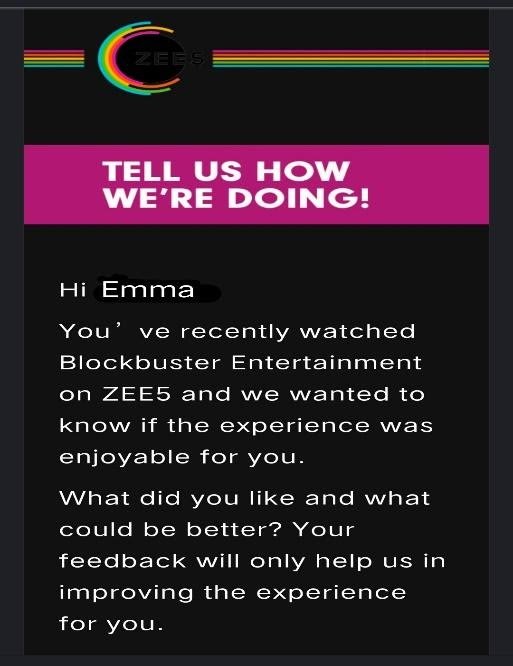
As we can see in this image above, it is personalized Content by a ZEE 5 application. You can see the message is directly addressed to the consumer by their name. It is an after-sale service where the brand is inquiring about its experience after binge-watching a show. Also, they are asking if there is any room for improvement from the brand’s side and requesting consumer feedback. This personal touch and regular whereabouts create a sense of Loyalty for the brand within the customers.
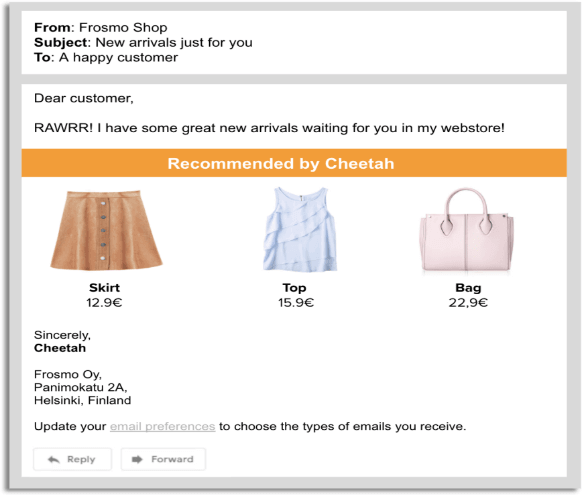
This is another email by a cloth brand. It is a personalized content email acknowledging the customer for the arrival of a new collection of clothes and accessories. It also has a personal recommendation of a few items, maybe considering its shopping history with the brand. Take a look at the subject; it goes as ‘New arrivals JUST FOR YOU.’ These words sum up the whole personalized Content.
Why does Personalized Content Marketing matter for brands?
Personalization is critical for your business’s success since online is one of the main options for the consumers for buying and selling; if the consumers feel listened to, they will respond accordingly.
The numbers don’t lie.
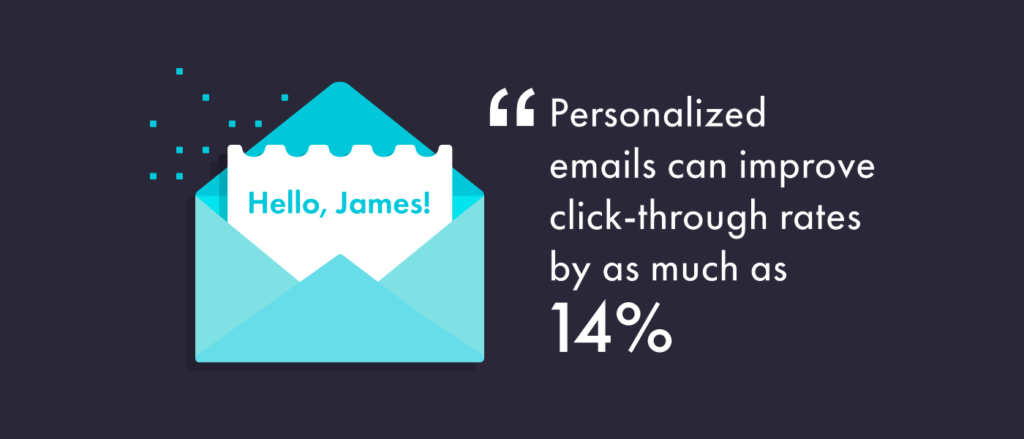
- Personalized emails tend to deliver six times higher transaction rates.
- Virtually all 96% of marketers agree that personalization advances consumer relationships.
- 80% of respondents say they saw a measurable uplift in their business from their Personalization Campaign.
- 89% of digital businesses are investing in personalized Content. These companies include big names like Coca-Cola, Netflix, Sephora, USAA, and Wells Fargo.
- Lack of personalized Content generates 83% lower response rates in an average marketing campaign.
- Personalization can reduce acquisition costs by 50%. It also lifts revenues by 5–15% and increases marketing spend efficiency by 10–30%
- Personalized Content facilitates repeated purchases in almost 44% of consumers.
- 91% of consumers are more likely to appear with companies with personalized Content and recommendations.
- Around 74% of online shoppers are frustrated when web content doesn’t target their interest.
- Marketers see an average increase of 56% in sales when they use personalized experiences.
- 92% of marketers reported using personalization techniques in their marketing.
- According to the consumers, 90% of consumers are willing to share their behavioral data if the brand provides benefits.
- 59% of customers say that personalization influences their shopping decision.
Source – https://instapage.com/blog/personalization-statistics
Personalized Marketing strategy differs from B2C and B2B according to the type of audience.
Personalized Content Marketing for B to C
Personalized Content Marketing for B to C is more or less generally the same process as mentioned before. B to C is a business setting where the businesses directly connect with customers to sell their products and services.
Gone are those days when traditional forms of advertising – TV and radio commercials, newspaper ads, calls, etc. – were enough to satisfy consumer’s demands for company and product information. The new consumer is more knowledgeable and knows about the marketing tactics. So, these old methods are not going to convince them to buy your product.
Thus, brands need to adopt new technologies and tactics to please their consumer. One of which is personalized content marketing. Instead of bombarding all customers with the same content, brands should go the other way around and add a personal touch to every content or message for your consumers. Content can be of different types such as email, video message, recommendations, SMS, etc.
Product recommendations “Inspired by your shopping trends/browsing history” are commonplace – as are messages that say “Customers who bought this also tend to buy this,” followed by a list of personalized recommendations of additional products that the retailer’s algorithms, “think” will interest the User.
Consider all the online streaming platforms such as NETFLIX, AMAZON PRIME. When you log on to their application, the site gives recommendations like, ‘Hey (users name) because you watched “STRANGER THINGS,” we might have a perfect series for you to watch today. And also, all the online music platforms like Spotify, Gaana, Apple Music suggest you some top picks, “Hello User, here is today’s hot trending list just for you. So, what are you waiting for? Plugin your earphones and enjoy some good music.”
Personalized Content Marketing for B to B
Business-to-business (B2B) is a typical transaction between businesses involving two business entities, manufacturers and retailers. Business-to-business refers to a business conducted between companies rather than between a company and individual consumers.
Personalizing the B2B buying experience not only converts a usually cold, robotic transaction into a human exchange but also paces up what tends to be a longer sales cycle. However, it’s easy for B2B sellers to think that their prospective consumers don’t buy with the same sentiment that B2C consumers do, therefore making personalization somewhat not necessary.
Surely having a website where dozens of prospective buyers can land at any moment means it’s better to have a general approach and create a “one-size-fits-all” strategy? But, while B2B buyers are more logical and goal-oriented than consumers as a whole, they still seek out personalized experiences.
Even though B2B content personalization is still improving in its first stages, it’s one of the biggest marketing trends and deservedly so. As a B2B company, using personalization will give you an edge over your competitors in customer acquisition, so it’s worth implementing sooner rather than later.
Thus, implementing a personalization strategy in a B2B setting will make these cold transactions more effective and human. And would attract more prospects.
Now, what are the sources of Personalized Marketing?
Types of Personalized Content
Nowadays, the consumer is fully expecting personalization in every campaign run by brands. Here are some of the examples of personalized campaigns that can lead to a great deal of success.
Personalized Email
To meet increasing consumer inclination towards personalized content, marketers are striving to establish Email Personalization as an important aspect of marketing strategy. A personalized mail is a mail sent by brands using subscriber’s data to provide them with more apt offers and ensure a good communication experience.
Personalization is a lot for email marketing. It enables brands to send more pertinent emails based on personal information that their users voluntarily share when subscribing to your email newsletter. There is a wide range of options for personalized email usage: from mass emails with personalized subject lines to behavior-based trigger emails like abandoned cart emails, reactivation emails, birthday emails, or recommendation emails.
Watch this video to make your email campaigns high performer
0 Comments